


If AI Continues Scaling From Here, Micron’s Current Price Could Look Embarrassingly Cheap
If AI Continues Scaling From Here, Micron’s Current Price Could Look Embarrassingly Cheap

Joel South Wed, October 7, 2026 at 10:55 PM UTC
0

Micron Technology Inc.Quick Read -
MU trades under 10x annualized earnings despite fiscal 2026 revenue surging 256% to $133 billion and non-GAAP EPS jumping 811%.
Micron's 26 Strategic Customer Agreements lock in $32 billion in commitments covering 35% of revenue through 2030, directly countering the cyclical bear case.
Ben Reitzes at Melius Research targets $2,200 while consensus sits 30% above current price, backed by 87% gross margins that signal a structural financial shift.
Just released. Our analysts combed the entire stock market and named the ten best stocks to buy right now, and Micron Technology didn't make the cut. Enter your email to see the names that beat MU. The report is free. Enter your email and see if any of your stocks made the cut.
Few stocks embody the AI infrastructure trade quite like Micron Technology (NASDAQ:MU). Shares have climbed roughly 273% year to date through early October 2026, riding a memory supercycle that CEO Sanjay Mehrotra calls a once-in-a-generation opportunity. The stock has now surpassed the $1,000 threshold that bulls were targeting just months ago, trading around $1,069 in early October after peaking at an all-time intraday high of $1,255 on June 25, 2026. With fiscal 2026 full-year revenue coming in at $133.2 billion and fiscal Q1 2027 guidance set at $61.5 billion, the question has shifted from "can Micron reach $1,000?" to "how much higher can it go?"
Free Report, Just Released
Why Didn't MU Make The Top 10 List?
24/7 Wall St has helped investors make money for over two decades, and our top analysts just finished ranking the definitive Top 10 Stocks To Buy Now. Not the ten biggest companies. Not the ten everyone is arguing about. The ten best stocks to buy right now.
And MU didn't make the cut!
The report is free, and you can see why we think each stock is a top investment today.
Enter Your Email and See the Ten →
Wall Street Has Had to Chase the Stock Higher
Analyst sentiment has become more uniformly bullish as results have consistently outpaced forecasts. According to S&P Global data, roughly 45 analysts now rate Micron a buy or strong buy, with only a handful of holds and no sells. The consensus 12-month price target has moved up to approximately $1,385 to $1,520 depending on the aggregator, a dramatic revision from the $740 to $860 range that prevailed earlier in the year. Top-tier calls reach as high as $2,200, from Ben Reitzes at Melius Research, while KeyBanc's John Vinh and UBS's Timothy Arcuri reiterated buy ratings with targets of $1,750 and $1,625, respectively, in early October. Micron has now beaten consensus EPS in seven consecutive quarters, including a 23.8% beat in fiscal Q3 2026.
Advertisement
The Math Behind $1,500 and Beyond
The original bull case for $1,000 per share has been validated. Now the conversation centers on whether Micron's earnings power justifies even higher prices. Fiscal Q3 2026 delivered a shock-and-awe report on June 24: revenue of $41.46 billion, more than quadrupling from $9.30 billion a year earlier, and non-GAAP EPS of $25.11. Both figures demolished prior guidance, which had called for $33.5 billion in revenue and $19.15 in EPS. Fiscal Q4 2026 (reported September 30) extended the streak, with revenue of $54.23 billion and non-GAAP EPS of $33.42 against analyst expectations of roughly $51 billion and $31.61, respectively. Full-year fiscal 2026 revenue landed at $133.2 billion, up 256% from the year before, while non-GAAP EPS rose 811% to $75.52.
Those numbers are not projections. They are reported results, and they are still accelerating. Micron guided fiscal Q1 2027 revenue to $61.5 billion with non-GAAP EPS of $38.15. At roughly $1,070 per share, the stock trades at less than 10 times annualized fiscal Q1 2027 earnings, a multiple that assumes the cycle ends abruptly. If management's multi-year visibility argument via Strategic Customer Agreements holds, the valuation looks increasingly out of step with the earnings trajectory. Gross margin reached 87% in fiscal Q4 2026, up from 37% non-GAAP in fiscal Q2 2025, an expansion that represents a structural change in Micron's financial profile rather than a temporary cyclical bump.
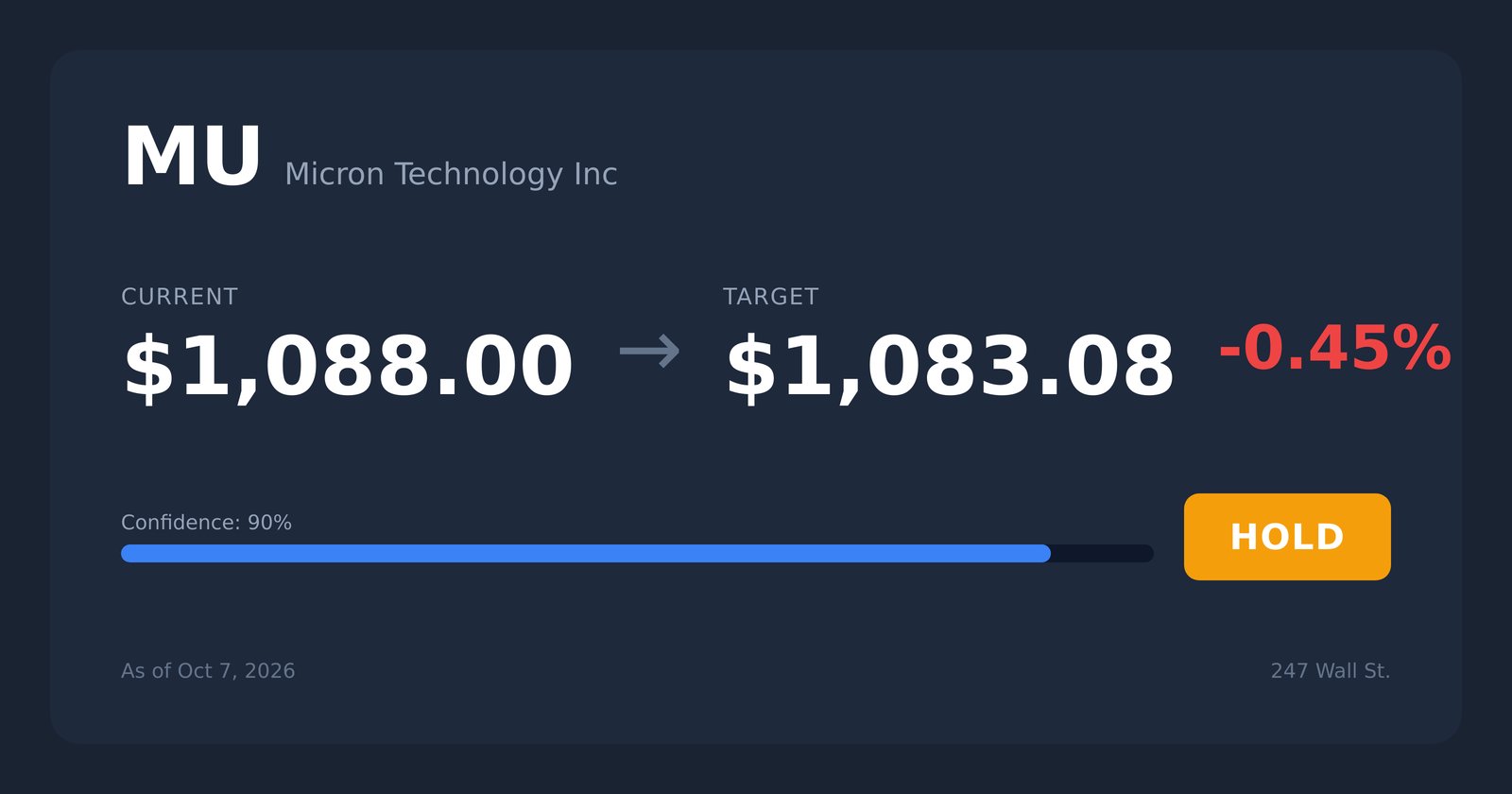
MU Price Target — 24/7 Wall St.Strategic Customer Agreements Change the Durability Argument
The most consequential development since the original $1,000 thesis was written is not the earnings trajectory; it is the structure Micron has put around it. During and after the fiscal Q3 earnings call, the company disclosed a new class of agreement called Strategic Customer Agreements (SCAs). These are multi-year, take-or-pay contracts with both volume commitments and floor-and-ceiling pricing structures. By the end of fiscal Q4, Micron had signed 26 SCAs covering roughly 35% of revenue through 2030, with customer financial commitments totaling $32 billion. HBM4, the next-generation high-bandwidth memory product, contributed more than $1 billion in fiscal Q3 revenue and is ramping at twice the speed of its HBM3E predecessor.
The SCA structure matters because it attacks the core bear case head-on. Memory cycles have historically been brutal precisely because pricing collapses when supply outruns demand. SCAs lock in volume and price floors for years, meaning Mehrotra's claim that Micron will deliver margins "well above prior cycle peaks even at floor pricing" is backed by contractual commitments, not just outlook language. Counterparties include hyperscalers and automotive customers, with supply so tight that even SCA customers are requesting additional allocation beyond their contracted volumes.
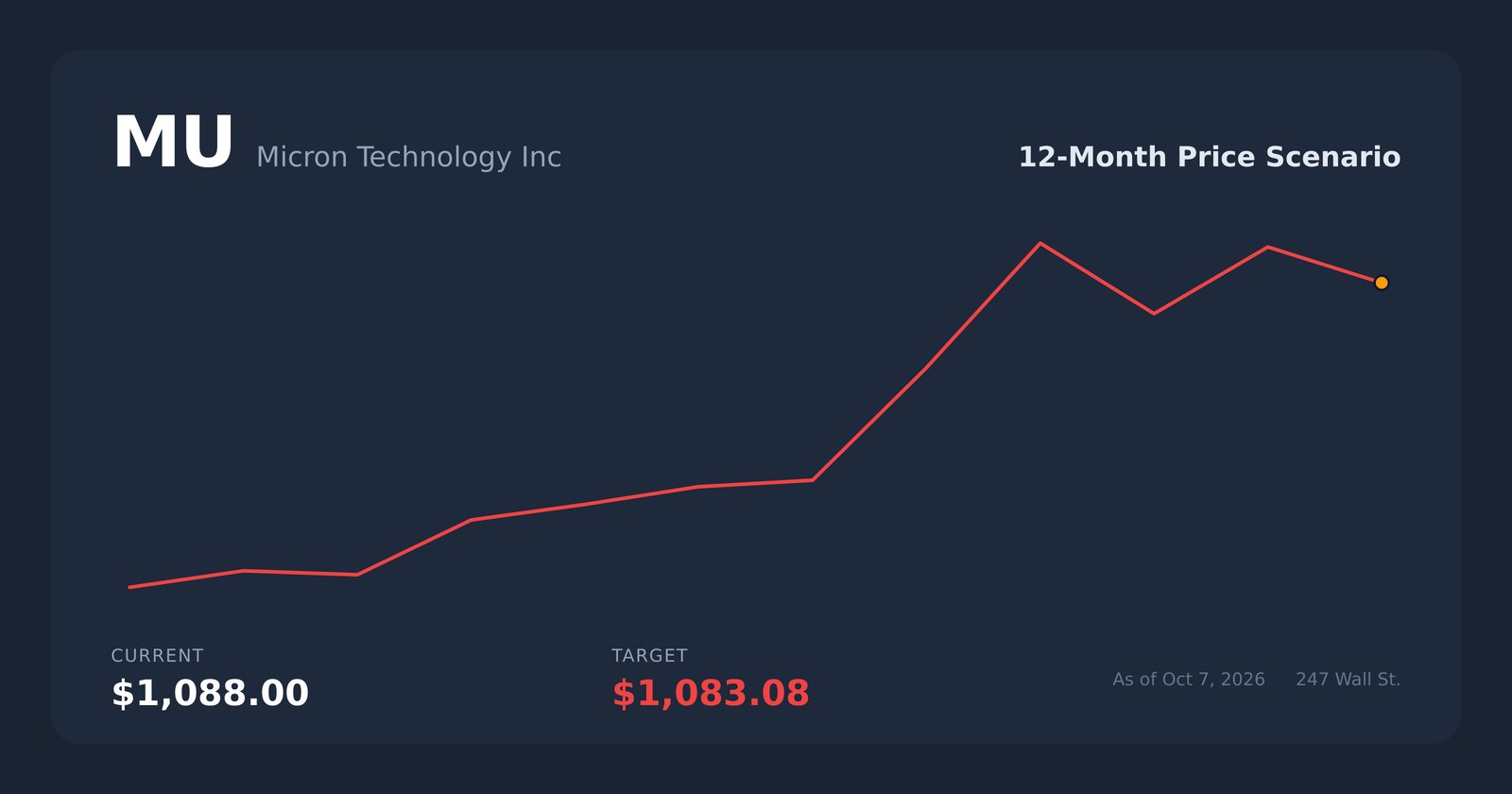
MU Price Scenario — 24/7 Wall St.History Says Outsized Gains Are in Micron's DNA
The stock climbed roughly 550% over the trailing twelve months ending October 2026, one of the steepest sustained rallies in semiconductor history. Memory cycles have repeatedly delivered multi-hundred-percent annual returns when supply tightens and pricing inflects, but the current cycle is unusual in both its speed and its depth: Micron's data center business, which generated just $1.53 billion in fiscal Q3 2025, reached $11.52 billion in fiscal Q3 2026 and $18 billion in fiscal Q4. Cloud Memory revenue followed a similar path, climbing from $3.39 billion to $13.77 billion in a single year.
Micron's market capitalization crossed the $1 trillion mark in late May 2026 and has moved well above that level since. The company was added to the S&P 100 in March, creating structural buying pressure from passive index funds. Supply constraints show no near-term relief, with Micron's own management and industry analysts citing tight conditions extending well beyond calendar 2026. More than 75% of fiscal 2027 shipments are reportedly locked in through supply agreements, a figure that gives the earnings outlook unusual visibility for a company historically at the mercy of spot pricing.
The Bottom Line: The Rally Is Real, and So Are the Risks
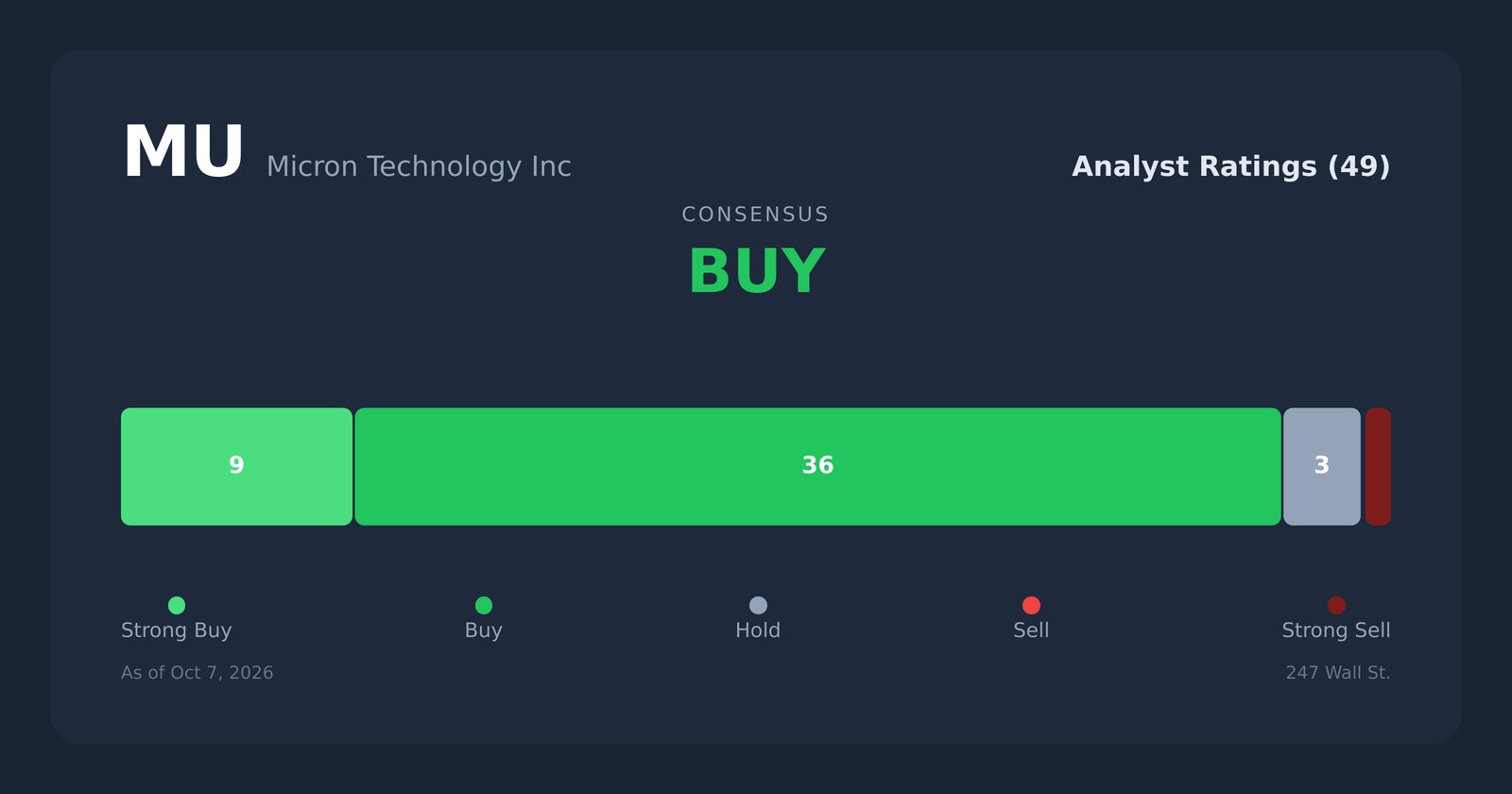
MU Analyst Ratings — 24/7 Wall St.
The path to $1,000 per share that bulls were debating a few months ago has already been traveled. The stock crossed that threshold in mid-2026 and has not looked back. Hurdles remain. Micron carries a beta above 1.9, making sharp moves in either direction a routine possibility. Some insiders trimmed positions during the rally. Competition from SK Hynix and Samsung in HBM remains intense, and Samsung's qualification progress at major AI chip customers is a risk that demands monitoring. Memory cycles do eventually revert, and the pricing visibility that SCAs provide has ceiling-price caps that would limit upside if spot prices climb further. But with gross margins at 87%, a quarter-trillion dollars in annualized revenue guidance for fiscal 2027, and analysts' consensus targets still sitting more than 30% above the current share price, the memory supercycle has moved from speculation to financial fact.
Editor's note: This pass the article's stock price and year-to-date performance to reflect early October 2026 trading levels; replaced the fiscal Q3 2026 guidance figures with the actual reported results (revenue of $41.46 billion, non-GAAP EPS of $25.11); incorporated fiscal Q4 2026 results (revenue $54.23 billion, non-GAAP EPS $33.42, gross margin 87%); added full fiscal year 2026 results ($133.2 billion revenue, $75.52 non-GAAP EPS); the all-time high to the June 25, 2026 closing peak of $1,213.37; revised analyst price target ranges to the current $1,385 to $1,520 consensus and the $2,200 high; added context on Strategic Customer Agreements (26 signed, $32 billion in customer commitments, 35% of revenue covered through 2030); noted that HBM4 revenue exceeded $1 billion in fiscal Q3 and is ramping faster than HBM3E; and the consecutive EPS beat streak to seven quarters.
Got $1,000? Before You Buy MU, Read This
If you have cash sitting in your account right now, give this two minutes. After more than two decades of helping investors beat the market, our top analysts at 24/7 Wall St. put together a definitive report on the Top 10 Stocks To Buy Today. And MU wasn't one of them.
They combed the entire market. It's not 10 ideas, not 10 stocks everyone is talking about, it's what their research points to as the 10 best stocks to buy right now, and it's free. Read more here and see which stocks made the list -->>
Contact editorial@247wallst.com for any questions or corrections.
Source: “AOL Money”
