


The Winners and Losers From Michigan's High-Stakes Senate Primary
The Winners and Losers From Michigan's High-Stakes Senate Primary

Philip ElliottWed, August 5, 2026 at 2:54 PM UTC
1.3K
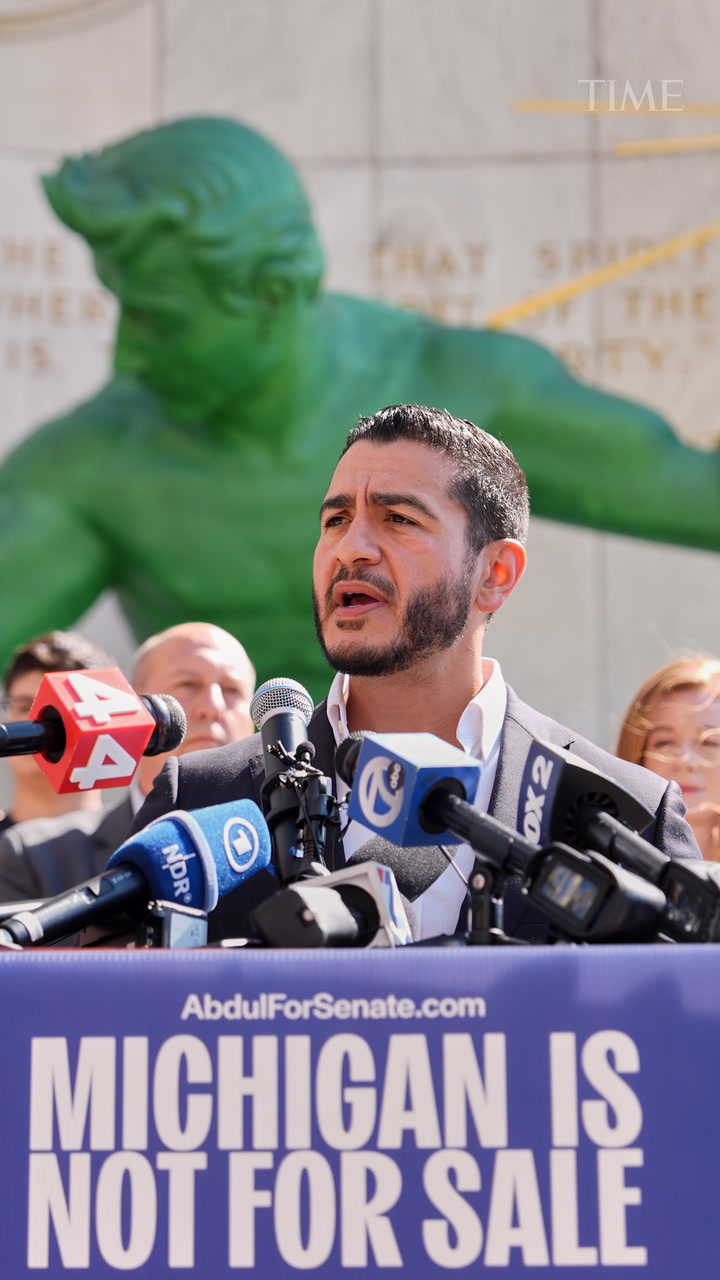
Abdul El-Sayed, a rabble-rousing populist and former public health official, just barely eked out a primary victory Tuesday in Michigan over a centrist rival who was the pick of Washington Democrats to keep a must-hold Senate seat. It was a bad night for the Democratic Establishment, who see the outcome as a major setback to their party's dreams of clawing back control of the Upper Chamber for the final two years of President Donald Trump’s presidency.
But El-Sayed’s squeaker win was not what he or his allies were forecasting as recently as Tuesday morning. For weeks, most polling indicated Michiganders were strongly trending toward El-Sayed, who would be the first Muslim Senator if he prevails in November over former Rep. Mike Rogers. Even still, this outcome was not something many foresaw as recently as last year. El-Sayed managed to captured the broad, bipartisan frustration that established leaders are not hearing voters’ concerns.
Strategists are still looking at the data but some top-line folks clearly came out winners—and others losers.
WINNER: El-Sayed
Even if he fell short of expectations, the podcasting populist still had the primary outcome he was counting on. El-Sayed has been planning this moment for a while. He ran for Governor in 2018, another wave year for Democrats, but lost his primary to the current Governor, Gretchen Whitmer.
As TIME’s Nik Popli reported from Michigan earlier this summer, El-Sayed is using his do-over to run against both parties at the same time. He blasted the wealthy, lashed the corporations, and decried the whole system as rigged. In many ways, he was channeling a lefty version of Trump.
El-Sayed, whose surprising rise prompted state senator Mallory McMorrow to suspend her campaign before voting began, is on the cusp of being the latest avatar for the brand of progressive and populist politics promoted by supporters like Rep. Alexandria Ocasio-Cortez or Sen. Bernie Sanders. That instant credibility may boost El-Sayed nationally, but risks turning off voters in Michigan, which is precisely what Rep. Haley Stevens warned of during her unsuccessful primary against El-Sayed.
LOSER: Stevens
She had almost every on-paper advantage: a seat in the House, proximity to donors and advocacy groups, a policy wonk’s eye, and an affable every-woman folksiness. But CVs don’t always translate to votes.
Stevens, a former campaign aide to Hillary Clinton and Obama, couldn’t translate her natural political instinct as an operative to convincing a statewide electorate that she deserved their votes. Sometimes, her comments seemed to wander. Her mind moved faster than her lips. And her critics—in not-so-subtly-gendered language—mocked her accent.
Her defeat Tuesday cuts short her time in public office. At least for now.
WINNERS: Populists
The frustrations with the status quo helped El-Sayed, for sure. But it also reflects the true sentiment of how Americans are feeling right now. According to Gallup polling, just 23% of Americans are satisfied with how things are going. With that level of angst, it’s little wonder that Michiganders opted to go with someone calling for remaking the whole system over an incrementalist and pragmatist who pitched herself as someone who can fix the system from the inside.
But, again, this result in Michigan may be a complicating factor as Democrats try to figure out their next leaders. The 2028 presidential primary is already shaping up as yet another soul-searching moment for Democrats, pitting the disparate ideological camps and competing personalities against each other. But winning primaries, even in swing states, doesn’t necessarily mean much when it comes to assembling a broader coalition. As one Democratic strategist told me before polls closed on Tuesday, the night “gives 2028-ers the wrong idea about everything.”
Advertisement
LOSER: AIPAC
The American Israel Public Affairs Committee became an unlikely flashpoint in Michigan. The pro-Israel group has been spending big for several cycles to support allies of Israel and counter increasingly anti-Israel sentiments in the Democratic Party. El-Sayed’s views there left little doubt which side AIPAC would be supporting.
The group spent a record $30 million to help Stevens, an outlay that fed El-Sayed’s characterization of his opponent as little more than a mouthpiece for her deep-pocketed supporters.
While the group is nominally focused on promoting the relationship between the United States and Israel, its advertising focus seldom mentions Israel. In fact, a New York Timesanalysis of AIPAC’s ads since April of 2022 found 109 ads. Just six mention Israel.
WINNER: CAIR
Michigan is home to one of the nation’s largest and most politically engaged Muslim communities. And one of its most important civic engagement groups, the Council on American-Islamic Relations, or CAIR, pulled a last-minute flex in the final hours of the race.
On the eve of Tuesday’s primary, CAIR began a robocall effort that reached more than 13,000 Muslim Michigan households, where roughly 29,000 mail-in ballot recipients are registered. Another 19,000 low-propensity Muslim voters got calls.
Given El-Sayed’s narrow win, that push looks even more impactful, allowing the country’s largest Muslim civil rights groups to more firmly showcase its power in Michigan, as it finds itself targeted on multiple fronts in some red states.
LOSERS: Establishment Democrats
Stevens was the undisputed choice of the Democratic Establishment. She was a swing state Democrat who previously won on the same ballot as Trump. She had been through the vetting, could raise money, and seemed a practical choice to hold the seat of retiring Democratic Sen. Gary Peters.
But Washington insiders’ efforts to help Stevens actually worked against her in a year when Democratic voters were more aligned with El-Sayed’s contempt for the Establishment. That anger found a vessel in El-Sayed and a target in Stevens. Even though Democratic leaders didn't get their way, that doesn't mean they're giving up on Michigan. Quickly after El-Sayed's primary victory became clear, Senate Minority Leader Chuck Schumer and Sen. Kirsten Gillibrand, the Democratic Senatorial Campaign Committee Chair, released a statement of support. “We look forward to working with Abdul and Democrats across Michigan to win this seat in November," they said.
ACTING LIKE WINNERS: Republicans
Senate Republicans have been rightly nervous about holding their narrow majority. El-Sayed’s nomination takes away some of that stress. While Michigan is expected to be a close race, Republicans were a lot more eager to run against El-Sayed than Stevens. Republicans are ready with plenty of fodder from El-Sayed’s past comments; his unrelenting criticism of Israel will be wielded to sway Michigan’s Jewish voters to either back Rogers or sit the race out.
LOSER: Whitmer
For the longest time, the state’s popular Governor insisted she was not getting involved in the primary. She had defeated El-Sayed to win the nomination in 2018 and has led a diverse state party through some tough family fights, especially when it came to the 2024 presidential race. Whitmer, who is term-limited and will leave office after November’s elections, is often mentioned as a 2028 contender. She has, with varying levels of intensity, said she is not chasing the nomination, but clearly isn’t ready to end her political career.
So it left a lot of watchers surprised when, on July 24, Whitmer endorsed Stevens. It was a move that another Michigan Democrat and oft-mentioned 2028 contender, Sen. Elissa Slotkin, did not make. Whitmer quickly became one of Stevens’ better surrogates, making the argument in a clearer way than the candidate herself did.
As the folks in Whitmer’s lane look around, they may be questioning if there is a lane for their likes heading into 2028, or if a principled stand for pragmatism is truly a non-starter.
Source: “AOL Breaking”
